Aktualisiert im September 2026 · Überprüft von Achille Mahieu, Immobilienexperte bei Oabitat in Rio de Janeiro
Every new development Oabitat currently represents in Rio de Janeiro is listed on this page — buildings still on the drawing board, units under construction, and finished blocks where the developer is selling the last apartments. Most of them sit in the Zona Sul, where almost no land is left and a genuine lançamento in Ipanema or Leblon comes along a handful of times a year.
Buying one of these is not the same transaction as buying a resale apartment. You are signing a contract for something that does not exist yet, paying for it in instalments that move with a construction index, and relying on protections written into Brazilian law rather than on the building you can walk through. The sections below explain exactly how that works. If you would rather start with the overview, read our new construction homes guide; if you want something you can move into now, see Wohnungen zum Verkauf in Rio de Janeiro.
Sources: Ademi-RJ launch figures, 12 months to June 2026; Índice de Lançamentos Imobiliários (DataZAP), March 2026. Tolerance period and retention limits under Lei 13.786/2018.
Brazilian agents use three phrases for what an English speaker would lump together as “new build”, and the difference decides how much you pay, when you pay it and what can go wrong.
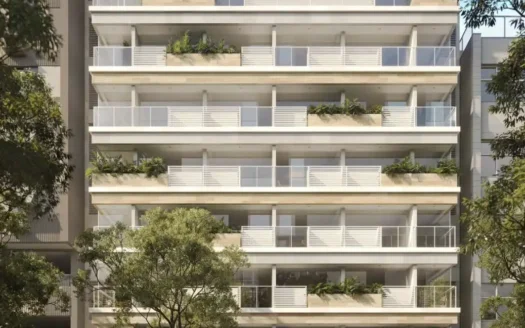
The building exists as a registered set of drawings and nothing else. Prices are at their lowest here and payment is spread across the whole construction period, typically two to four years. This is where the discount lives and where the risk lives, which is why the rest of this page is mostly about it.
Foundations are in and the structure is going up. You can see what you are buying and the delivery date has become credible, but you pay more than the buyers who signed at launch, and you still carry the remaining instalments and the same delivery risk.
The building is complete and has its Bewohnungsgenehmigung, the occupancy certificate from the city. The developer is selling remaining stock. You are buying a normal apartment that happens to be brand new: full price, immediate handover, ordinary financing, none of the off-plan mechanics. Some of the listings on this page are in this category.
The sequence is fixed by law and is the same for a Brazilian buyer and a foreign one. Nothing here is negotiable in a way a good deal would ever require.
Before a single unit may legally be offered for sale, the developer has to file a memorial de incorporação at the property registry and have the incorporation registered under Lei 4.591/64. That filing contains the plans, the technical specification, the land title and the breakdown of every unit. It is a public document. If a project cannot show you its registration number, the correct response is to walk away — selling before registration is not a technicality, it is the thing the law was written to stop.
Since 2018 every off-plan contract must open with a quadro-resumo, a summary table stating the total price, the payment schedule, the delivery date, the indices used and — in plain figures — what you lose if you cancel. Read that table before the contract. It is the one page where the developer is legally required to be unambiguous.
During construction your instalments are not fixed. They are corrected each month by the Índice Nacional de Custo da Construção, the construction cost index published by Fundação Getulio Vargas, using the rate released two months earlier. This is normal and it is in every contract in the country, but it means the number in the brochure is not the number you will pay. Budget for it. After handover the correction switches to whatever index your bank contract uses.
Delivery happens once the city issues the Bewohnungsgenehmigung. At that point the balance falls due, and most buyers who are not paying cash arrange a mortgage against the finished apartment — you cannot mortgage a building that does not exist yet, which is why the instalment structure exists in the first place.
The deed is registered in your name at the Grundbuchamt. ITBI, the municipal transfer tax, is 3% in Rio de Janeiro and falls at this point rather than at signature, along with notary and registration fees. Foreign buyers need a CPF, the Brazilian tax number, and can hold urban residential property on the same terms as a Brazilian — the restrictions people have heard about apply to rural land, not to an apartment in Ipanema. Our Rechts- und Steuerleitfaden covers the documents in detail.
Almost everything that goes badly wrong with an off-plan purchase in Brazil is covered by one of these two rules. Both are worth understanding before you look at a floor plan.
A developer may place a project under patrimônio de afetação: the land, the works and the buyers’ money are legally fenced off from the rest of the company. If the developer goes under, those assets do not fall into the bankruptcy estate, and the buyers meet in assembly and decide whether to finish the building themselves or wind it up. It is the single strongest protection available to an off-plan buyer in Brazil, it was added to Lei 4.591/64 by Lei 10.931/04 — and it is optional. The developer chooses. Check the registry entry, not the sales brochure.
The part that rarely gets explained: the same regime cuts the other way if you are the one who withdraws. On an ordinary project the developer may retain up to 25% of what you have paid. On a project under patrimônio de afetação that ceiling rises to 50%, and your refund is only due 30 days after the building is certified complete rather than within 180 days. Better protection against their failure, a heavier penalty for your change of mind. Decide with that in view.
Contracts may give the developer up to 180 days beyond the stated delivery date before the delay counts as default. Inside that window a late building is simply late. Past it, the position reverses completely: the retention limits stop protecting the developer, and you may demand everything you have paid back in a single payment, plus the contractual penalty for the delay. When you read the quadro-resumo, the delivery date that matters is the stated one plus 180 days.
Rio launched roughly 25,000 residential units in the year to June 2026, the strongest cycle the city has seen in over a decade — but they are not spread evenly, and most of that volume is nowhere near the beaches foreign buyers have in mind.
Ipanema, Leblon, Copacabana, Botafogo and Lagoa have almost no undeveloped land. New buildings here come from demolition and replacement of older blocks, so they arrive a few at a time, they are small, and they sell before completion. This is where our own inventory is concentrated: see Ipanema und Leblon for everything available in those two neighbourhoods, new and resale.
The Reviver Centro programme and the 2024 master plan opened the historic centre and the port district to residential conversion and new towers, and that is where a large share of those 25,000 units sit. They are compact, often without parking, and aimed at a domestic first-home buyer using FGTS. Different product, different buyer, and not what most of our clients are looking for — but it is the reason the city-wide statistics look the way they do.
The average launch price in Rio reached R$12,850 per m² in March 2026, up 68.5% in twelve months. That number is real but it is not pure appreciation: the market shifted from two- and three-bedroom apartments towards compact units, and the smaller the apartment, the higher its price per square metre. Read a headline like that as a change in what is being built, not as a measure of what an existing Ipanema apartment gained in a year. For that, the price per square metre by neighbourhood is the honest comparison.
It suits a buyer who has time and does not need the apartment now. You are trading three or four years of waiting, plus delivery risk, for a lower entry price and a payment schedule that lets you buy a better address than your cash balance would otherwise reach. That is a good trade for an investor building a position and a poor one for someone relocating in six months.
It suits a buyer who will do the paperwork, or pay someone to. The registry check, the quadro-resumo, the developer’s track record on previous projects — none of it is hard, but skipping it is how people end up in the cases that make the newspapers.
It does not suit a buyer who wants rental income from day one. Nothing earns until the keys are handed over. If the return is the point, an existing apartment in a building that already works is usually the better instrument — see Airbnb-friendly apartments or the long-term rental market.
Yes. A foreign individual can buy urban residential property in Brazil on the same terms as a Brazilian, whether it is off-plan or finished. You need a CPF, the Brazilian tax number, which can be obtained from abroad through a Brazilian consulate. The restrictions that exist apply to rural land and to property near the border, not to apartments in the city.
There is no legal minimum. In practice developers ask for an entry payment of roughly 20% to 30% of the price, then monthly and half-yearly instalments through construction, with a balance at handover that most buyers finance or pay in cash. The exact split is set project by project and is stated in the quadro-resumo.
The INCC is the national construction cost index published by Fundação Getulio Vargas. Your instalments are corrected by it every month during construction, using the rate published two months earlier. Over a three-year build it typically adds a meaningful amount to the headline price, so ask for the schedule to be modelled with a realistic index assumption before you sign, not just at today’s nominal price.
It depends entirely on whether the project is under patrimônio de afetação. If it is, the project’s assets are ring-fenced from the bankruptcy and the buyers decide in assembly whether to complete the building or liquidate. If it is not, you are an unsecured creditor alongside everyone else. This is the single most important thing to verify, and it is verifiable at the property registry.
You can cancel, but not for free. Under Lei 13.786/2018 the developer may retain up to 25% of what you have paid, or up to 50% if the project is under patrimônio de afetação and this is properly registered and disclosed in the contract. The position is different if the developer is the one in default: past the 180-day tolerance period you can demand the full amount back in one payment.
Up to 180 days beyond the contractual date, if the contract provides for it, and that clause is standard. Beyond that the developer is in default and you may terminate with a full refund plus the contractual penalty, or hold them to the contract and claim the penalty for the delay.
ITBI, the municipal transfer tax, is due when the transfer is registered, which on an off-plan purchase happens at the end. In Rio de Janeiro the rate is 3%. Notary and registry fees fall at the same point.
At the moment of signing, yes — a launch price is set below the expected finished value, which is what compensates you for the wait and the risk. Whether it stays cheaper depends on the INCC correction across the build and on what the market does in the meantime. It is a genuine discount, not a guaranteed profit.
A few, and they are the reason this page exists. Both neighbourhoods are effectively built out, so new buildings only appear when an older block is demolished and replaced. Volumes are small, units sell before completion, and a project is often quietly placed before it is publicly marketed. Everything we have is listed above.
The overview of Rio’s new-build market: featured projects, the South Zone pipeline and what is coming.
Lesen Sie den Leitfaden →The full purchase process for a foreign buyer: offer, certidões, deed, registration and costs.
Lesen Sie den Leitfaden →CPF, contracts, ITBI and registration — what a foreign buyer signs and what each step costs.
Lesen Sie den Leitfaden →Ready to move into, no waiting and no construction risk — the rest of our sale inventory.
Browse listings →Where most of Rio’s few genuine Zona Sul launches appear, and where our stock is concentrated.
Entdecken Sie Ipanema →The most expensive square metre in Brazil, and a handful of replacement buildings a year.
Entdecken Sie Leblon →Tell us your budget and your timeline and we will tell you what is actually coming, which developers we would sign with, and whether waiting three years beats buying something finished today.
Vereinbaren Sie einen BeratungsterminA password will be e-mailed to you