

This legal and tax guide to Rio de Janeiro property covers the paperwork, the taxes, and the professional help you'll actually need as a foreign buyer — starting with the five Portuguese terms that show up in every transaction (matrícula, cartório, escritura pública, ITBI, IPTU) and working outward to income tax, visas, and how to avoid the scams that target buyers who skip this step. Brazilian property law isn't harder than what you're used to at home; it's just different, and it's written in a language most of our clients don't read. This is the plain-English map.
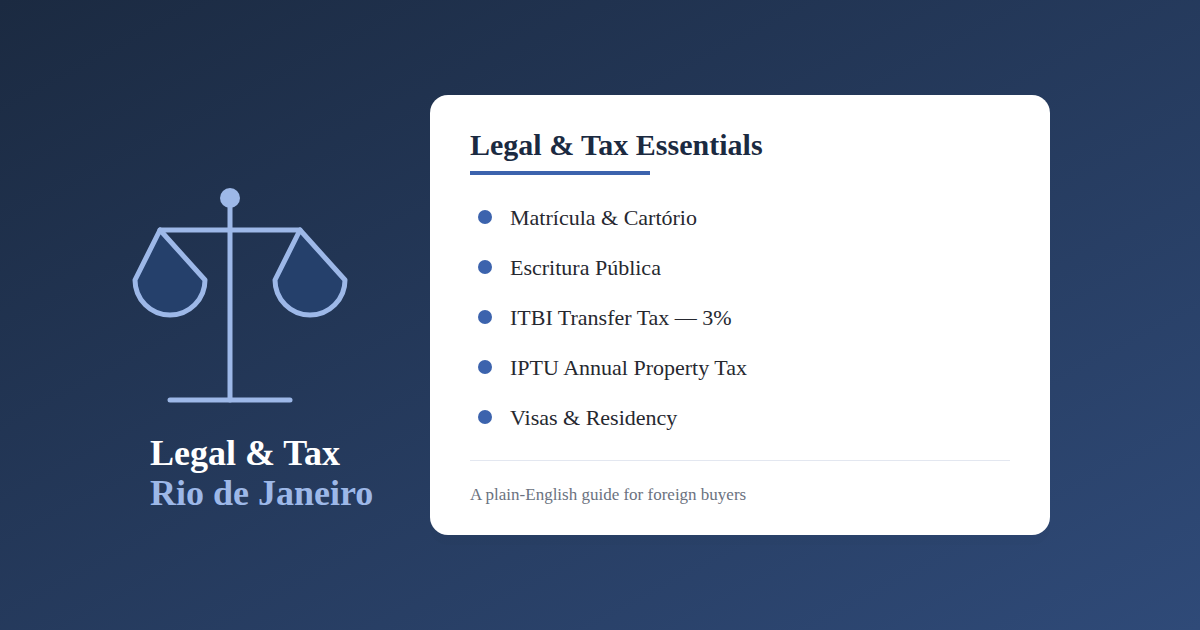
Five terms carry almost the entire legal and tax Rio de Janeiro transaction. Once you know what each one actually does, the rest of the process makes a lot more sense.
The matrícula is the property's official record at the Cartório de Registro de Imóveis (Real Estate Registry Office) — a continuous history of every ownership transfer, mortgage, lien, usufruct, and court attachment tied to that specific address. It's the single source of legal truth for who owns a property and what encumbers it.
Why it matters: A clean, recently issued matrícula (request one updated within the last 30 days) is the foundation of due diligence — but it isn't the whole picture. It won't show the seller's personal lawsuits or fiscal debts, which is why a proper check also pulls separate certidões on the seller. See our full due diligence guide for the complete five-check process.
"Cartório" covers two distinct offices that do very different jobs. The Cartório de Notas drafts and authenticates legal instruments — this is where you sign the escritura pública, and where a notary (tabelião) confirms the transaction and the parties' identities. The Cartório de Registro de Imóveis is the property registry — it's where the signed deed actually gets filed against the matrícula.
Why it matters: Signing at the Cartório de Notas doesn't transfer ownership by itself. Brazilian law follows the principle "quem não registra, não é dono" — who doesn't register isn't the owner. The sale isn't complete, and isn't safe from a competing claim, until it's recorded at the Cartório de Registro de Imóveis.
The escritura pública is the formal deed of sale, signed before a notary — required by law for essentially every Rio property transaction. It's different from the promessa de compra e venda (the private pre-contract signed earlier, which locks in price, deposit, and conditions like financing or document clearance) and from a private sale contract, neither of which transfers legal ownership on their own.
Why it matters: Buyers sometimes assume the deal is done once the escritura is signed. It isn't — ITBI has to be paid first (notaries won't complete the deed without proof), and the signed deed still has to be taken to the Cartório de Registro de Imóveis to actually transfer ownership.
Imposto de Transmissão de Bens Imóveis — Rio de Janeiro's municipal property transfer tax, a flat 3% of whichever is higher: the declared sale price or the city's assessed value (valor venal). It's paid by the buyer and must be settled before the escritura is signed; the notary requires proof of payment. A handful of exemptions apply (transfers under R$12,000, some social-housing programs), but there's no general first-property exemption.
Why it matters: Budget for it as a closing cost, not an afterthought — together with notary and legal fees, ITBI is typically the largest single line item in the roughly 5% total closing costs that come up in almost every legal and tax Rio de Janeiro conversation we have with buyers.
Imposto Predial e Territorial Urbano — the annual municipal property tax every owner pays. In Rio de Janeiro the standard rates are 1.0% of assessed value for residential property, 2.5% for commercial, and 3.0% for unbuilt land. It can be paid as a lump sum (with a discount) in February or spread across up to ten monthly installments through the year.
Why it matters: IPTU debt attaches to the property itself, not just the person who owed it — confirm the seller's IPTU is fully paid before closing, or you can inherit the bill. See our full IPTU 2026 Rio guide for exemption thresholds and payment mechanics.
A municipal certificate confirming a building was constructed or renovated according to its approved plans and meets safety and habitability standards, issued by the prefeitura after inspection.
Why it matters: Without a habite-se, a property generally can't be formally registered or financed by a bank — its absence on a "finished" building is a real red flag, covered as one of the five checks in our due diligence guide.
Beyond the one-time ITBI transfer tax, owning and renting property in Rio comes with its own recurring tax calendar. Here's where to go deeper on each one.
Current rates, exemption thresholds, and payment schedule for the annual municipal property tax.
Read the guide →The lesser-known annual municipal fire-safety tax that catches new owners off guard.
Read the guide →What taxa de condomínio actually covers, and how to budget for it alongside IPTU.
Read the guide →The full picture for anyone earning rental income or living in Brazil part of the year.
Read the guide →Essential information for landlords, including the 2026 rental income tax reform.
Read the guide →Buying property doesn't automatically grant residency, but it can open the door to it — and residency status changes some of the tax questions above.
The investor visa pathway (VITEM IX) and how dependents are added to your application.
Read the guide →What changed for short-stay visitors, and what it means if you're property-hunting on a tourist visa.
Read the guide →None of the above replaces a licensed Brazilian lawyer. Here's how to find the right one, and how to spot the schemes that target buyers who skip that step.









A password will be e-mailed to you